
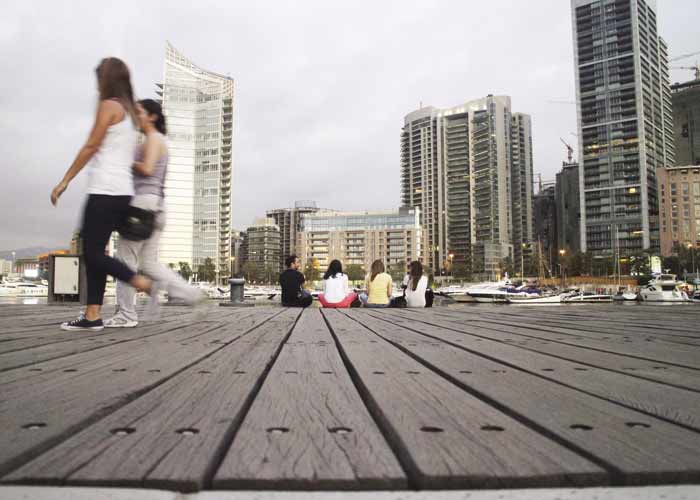
An article on the effects of the real estate construction boom in Beirut, published in The Arab Weekly in April 2015.
Fifteen years of a destructive civil war, a major Israeli invasion and countless rounds of violence caused extensive damage to Beirut’s Levantine character. But a post-war real estate boom has had even more devastating consequences on the city and its social fabric.
Over the past decade, construction cranes and scaffolding have become an inescapable part of Beirut’s skyline. Luxury residential complexes and office towers have mushroomed, almost wiping out the capital’s public spaces, destroying its architectural heritage and dealing a severe blow to hopes of sustainable urbanism.
The rise in construction is explained in large part by the exorbitant profits for developers, according to Jamil Oueini, real estate manager in Beirut.
“The real estate profit for developers is between 200% and 400%. So you build a big tower, you sell three or four apartments and you’ve already paid off the costs for the rest of the building,” Oueini told The Arab Weekly.
According to the Global Property Guide, prices for apartments in central Beirut were typically between $4,200 and $6,800 per square metre in 2013 – 3.5 to 5.6 times more expensive than in 2004, when they averaged $1,200 per square metre.
As a result, hundreds of old buildings have been torn down to capitalise on the land they were built on. According to Naji Raji, founder of a local non-government organisation, “Save Beirut Heritage”, the capital city counted around 2,000 old houses at the end of the civil war in 1990. Today, Raji said, only 180 to 200 remain.
He explained in an interview with The Arab Weekly that investors often end up selling notable architectural details of old houses piece by piece, whether it be tiles, doors or carved stone staircases, all the while arguing that the houses they destroy are worthless.
“They’re even profiting from the pieces,” he said.
“The architecture is important not just as aesthetic heritage but as memory of the fabric of the city. These houses are being replaced by shapes and forms that have nothing to do with the character of the neighbourhood,” architect and urbanist Abir Saksouk said, noting that the eviction of former tenants was also changing the social composition of the city.
Saksouk’s argument was strongly backed by Raji who said that only two families remain in the street where he grew up in the neighbourhood of Gemmayzeh. The place, once a calm residential quarter, became a night hub with old houses turned into restaurants and pubs blaring music.
“Everyone had left because they can’t afford to live there. The area doesn’t belong to them anymore,” he noted sadly. “Beirut is controlled by companies now. Every building is a profit.”
This lucrative business has also had a dire effect on public space, as real estate promoters have taken advantage of legal loopholes to effectively take over much of the Lebanese coast, severely affecting the ecosystem and restricting access to the sea to a select few.
Opportunities to create more green spaces in Beirut have also been stifled by the competitive rush to buy terrain for high-rise buildings. The city only has 0.8 sq. metre of green space per resident, a far cry from the World Health Organisation’s recommendation of 9 sq. metres per person.
“The municipality should be the one buying more land to create more public spaces. It should have a clear-cut position on this issue,” Beirut Green Project co-founder Dima Boulad argued. “Having green spaces is a right, not a privilege.”
For Saksouk, the preservation of public space is a social and political necessity. “In a city where communities are often divided along sectarian lines and in sectarian neighbourhoods, communal spaces become extremely important,” she said.
The dearth of public spaces, she said, is “an obstacle for these communities to interact”.
In addition to sacrificing Beirut’s traditional character to modernisation, the real estate boom has taken its toll on the city’s precarious infrastructure. Those responsible for the construction of high-rise buildings often do not feel concerned with ensuring potential residents have access to basic services.
“There is zero urban planning,” Oueini explained. “Last summer there was a huge water crisis and it’s all because there’s no infrastructure. There are no dams. There’s no planning.”
The “takeover” of Beirut by developers and entrepreneurs in the construction sector, has been facilitated by loose governmental oversight.
“It happens a lot that developers destroy houses before getting approval from the ministry,” Raji said. “Sometimes they do this cunning trick where they remove the balconies, the windows, the arcades — everything important — then go to the ministry and claim that it has been destroyed like that during the war.”
Mona Harb, an associate professor of Urban Studies and Politics at the American University of Beirut, said political collusion was also to blame. Many of the major real estate promoters in Lebanon are related to or affiliated with politicians.
“Beirut’s lack of proper urban planning is strongly related to the convergence of private real-estate interests and political elites’ interests,” Harb told The Arab Weekly.
“We have a relatively good set of laws that urban planners could work along if they were given the means to. But people who want to make a change within the system are discouraged, because public administration is dominated by corruption and sectarian politics.”
Harb argued that electoral laws, which dictate that citizens vote in their town of origin, not of residence, hinder the ability of Beirut’s residents to hold their local and national-level representatives accountable.
“The majority of people who benefit from public services in Beirut do not get to vote for the ones who manage these services. These are kept in power by a minority of dwellers who vote for them based on sectarian interests and fears,” she said.
But on a more positive note, Harb pointed to noteworthy local development efforts by some mayors in Lebanese towns as a proof that there are possibilities and opportunities for good urbanism to occur.
Boulad agreed, adding that citizens also have a crucial role to play in raising awareness of the issue and compelling political leaders to enact change.
“There isn’t any urban planning with a real vision on the long term in Beirut,” she said
To many, Beirut is no more the city they knew and enjoyed.


Leave a Reply