
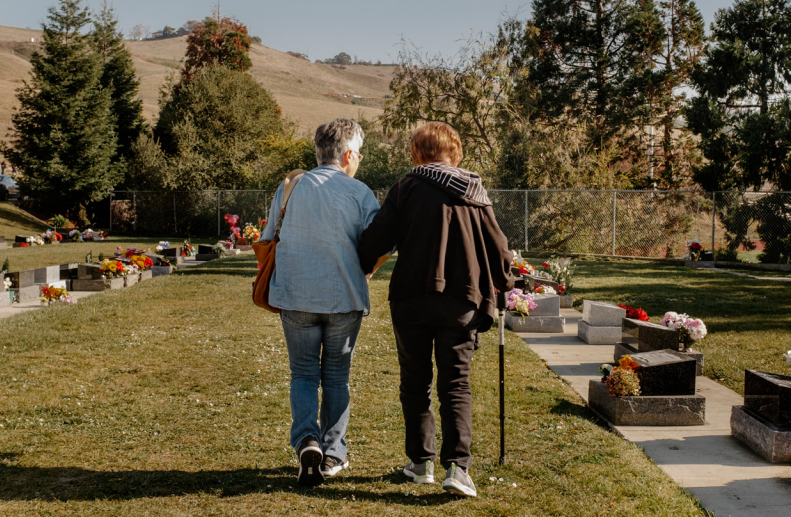
An in-depth feature article looking at the experience of dementia within the LGBTQI+ community, published in September 2023 in the World Alzheimer Report.
Stigma and discrimination play a huge role in influencing both behavioural and environmental risk factors among sexual and gender minorities – leading advocates and researchers to argue that societal acceptance is key to addressing dementia within the community.
Mike Parish remembers the moment he first locked eyes with Tom Hughes in 1975, when they were only 19 years old.
“I leaned forward, he leaned forward, and that was it, we fell in love,” he recalls with a smile.
The two young men quickly became a couple, at a time when being openly gay was both illegal and dangerous in the United Kingdom.
While the 1967 Sexual Offences Act nominally decriminalised homosexuality in private for men over the age of 21, sexual and gender minorities – also known under the umbrella acronym of lesbian, gay, bisexual, transgender, queer, and intersex (LGBTQI+) – faced heavy policing and harsh sentences for decades afterwards. It was only in 2001 that the age of consent between two men was lowered to 16 on par with their heterosexual counterparts, and in 2013 that gay sex was fully decriminalised in the entirety of the United Kingdom. Not long after that, Mike and Tom finally got married in 2016, after 41 years together.
By that time, however, Tom’s health had been worsening. After around a decade of cognitive decline, he was diagnosed with cortical basal degeneration, a rare form of frontotemporal dementia, in 2019.
Tom passed away at home in September 2022. For Mike Parish, the years of caring for his life partner have left him convinced that more needs to be done to make sure that members of the LGBTQI+ community have access to better resources, support, and awareness when it comes to dementia.
“I was in this situation with my partner where I was experiencing living grief, and I was trying to find support,” says Parish, who helped create the LGBTQ+ Dementia Advisory Group (Community Interest Company) in 2020. “People would say: ‘Well, of course, there’s online, you can go to psychologists, you can find support groups.’ I’d done all of that, but I felt very strongly that I needed to communicate with people who I didn’t have to explain my life to.”
While there have been strides in recent decades in LGBTQI+ acceptance, members of the community across the world continue to face discrimination and violence in their day-today lives because of their gender and sexual identities, even in countries where LGBTQI+ rights have been enshrined into law. According to the International Lesbian, Gay, Bisexual, Trans and Intersex Association (ILGA), homosexuality is still criminalised in 64 countries, while 111 out of 174 countries and locations had a score of five or under on the 10-point Global Acceptance Index in 2020.
Increasingly, researchers and advocates argue that the discrimination LGBTQI+ individuals face throughout their lives has an impact on their likelihood of developing dementia later in life, as well as their experience of the condition once diagnosed – and that tackling prejudice should be an essential component of risk reduction efforts within the community and beyond.
“Do I think that Alzheimer’s and dementia are a social justice issue? Yes, absolutely,” says Dr Jason Flatt, an assistant professor at the University of Nevada, Las Vegas School of Public Health. “Both in terms of risk, and in terms of when you do have dementia, your access to care and resources are not the same.”
Risk and prejudice
Some known modifiable risk factors of dementia such as depression, substance abuse, smoking, and social isolation play out with particular significance within the LGBTQI+ community, Flatt explains.
“When we think about the social community and spaces that have been traditionally safe for LGBTQ+ people, they have been bars. There is a bar culture that’s a part of the LGBTQ+ community and that could potentially suggest greater access to alcohol.”
For Barry Moss, a former psychiatric nurse currently working as dementia services development advisor at Age UK, a lot of risky behaviours can be viewed as a response to the stigma that LGBTQI+ people face from their families and broader society.
“You’re discriminated against by the church, by the community, by elders, by family, by peers… and then you start feeling: ‘It must be because there’s something wrong with me,’” he says. “You start to look for ways of coping with the anguish, and that’s when addiction comes in. To me, that’s self-harm.”
Surveys over the years have consistently seen higher reported rates of depression, anxiety, and drug use among LGBTQI+-identifying individuals compared to the rest of the population.
Flatt’s research has meanwhile found higher rates of subjective cognitive decline (a possible precursor to mild cognitive impairment and dementia) among people aged 45 and older identifying under the LGBTQI+ umbrella than among their heterosexual counterparts.
A 2022 study by Queen Mary University found an association between ethnicity and socioeconomic disparity (factors which are often correlated) and dementia risk. Flatt believes the findings of this study could easily be transposed to the LGBTQI+ community.
“The idea that certain groups of people are lesser than others, so they’re not entitled to the same wages, the same opportunities for education, the ability to live in high-resourced neighbourhoods with quality healthcare, with access to a grocery store that will have fresh fruits and vegetables… That social deprivation, I think, contributes to the risk factors that we talk about, and why we see them in the LGBTQ+ community” as well as other marginalised groups, he notes.
Discrimination impacts members of the LGBTQI+ community to different degrees, advocates note, with transgender individuals (especially trans women) and people of colour more likely to be affected by systemic discrimination, hate crimes, and precarious economic situations – increasing their exposure to dementia risk factors.
“It’s still not neutral to be LGBTQ+,” says Julien Rougerie, programme manager for Fondation Émergence, an LGBTQI+ rights organisation in Québec, Canada. “There are many disparities [within the community], and trans people are especially vulnerable to all the risk factors, while facing more barriers to access care.”
Navigating the hurdles of dementia
While there has been increased societal awareness and acceptance of the LGBTQI+ community in recent decades – even if those fragile gains are happening unevenly across the world and can be under threat even in more progressive countries – the so-called Stonewall Generation continues to face hurdles.
LGBTQI+ individuals aged 60 and over have lived through momentous periods of history such as the 1969 Stonewall riots; the HIV/AIDS epidemic that decimated the gay community in the 1980s and 1990s; homosexuality and transness being classified as “mental disorders” by the World Health Organization until 1990 and 2019 respectively; and same-sex marriage becoming legal in more than 30 countries since 2001.
“If we had held hands or kissed in public, we could have been arrested and imprisoned,” Parish says of the early years of his relationship with his husband. “We had people say things to us on the way to work, on the way home from work, at work, on the train, in cafés…”
Tom, he says, lost his ability to see out of his left eye after a homophobic attack.

“You carry that anxiety or risk radar with you,” Parish adds. “When you go into a room full of heterosexual people, you’re on your guard because they might not agree with your lifestyle or don’t acknowledge that a long-term, loving relationship is even possible between two people of the same sex.”
In addition to the impact of these heightened stress levels on one’s health, historic and ongoing prejudice affect the trust that LGBTQI+ elders have in the health and social systems designed to provide diagnosis, treatment, care, and support for dementia.
Parish says Tom’s HIV-positive status led healthcare workers to dismiss any other possible causes for his worsening cognition. While HIV can be associated with a heightened risk of developing dementia, it is now rare thanks to the more widespread use of antiretroviral therapies.
“Nobody was going for the more obvious analyses, like MRIs or spinal taps, because they were so convinced it had to do with HIV,” Parish recalls.
Flatt concurs, saying he has spoken to elderly LGBTQI+ individuals about their negative experiences with the healthcare system.
“I’ve heard from seniors who go to the doctor and say: ‘My shoulder’s bothering me,’ and the doctor will want to do a throat swab or test for gonorrhoea… It’s a stigmatising type of care,” he says, adding that it deters people from “coming back ever again because of how they were treated in that encounter”.
Long-term care homes can also be rife with homophobia, transphobia, or other abuse from staff and fellow residents – sometimes with deadly consequences.
“There’s so much meaningful care, loving care, that – because of the LGBT aspect – I could not hand over to somebody else,” Parish says of his decision to care for his husband at home. “It is so hard knowing that you put them in the hands of somebody, who you don’t know if they respect them and understand them as well as you do. That’s one of the hardest things about it, and that’s why it’s very different for this community – and other minorities.”
Meanwhile, the cliché portrayal of the LGBTQI+ community as overwhelmingly young renders its older members invisible, even among their peers. Coupled with longstanding distrust of health care institutions, this often means that dementia risk is not considered a health priority, and that diagnosis can take place long after the first warning signs have appeared, if at all.
In the United States, it is estimated that LGBTQI+ people over the age of 50 are twice as likely to live alone and four times less likely to have children than the national average.
For Moss, the AIDS epidemic plays a role in this dynamic. “They lost their peers – people of the same age, who lived in the same city, who partied together, who socialised together, who became members of their family of choice – saw them pass away due to disease,” he says. “This has a huge effect on the psyche, on trust, especially for older gay men… This is all based on bereavement and life experience.”
The lack of social recognition of “chosen families” and the prioritisation of biological relatives, regardless of the state of their relationship with the person living with dementia, further isolate LGBTQI+ people in need of care.
“When someone loses autonomy, whether it’s cognitive or physical issues, the reflex is to only talk about ‘family’ – as if, past a certain age, your family is your only social network,” Rougerie says. “Sometimes those who are part of the chosen family aren’t acknowledged in these [health and long-term care] environments. There’s always the threat that the traditional, biological family could put into question the role of the informal caregiver.”
The long road ahead
One thing those who spoke to ADI all agree on: things are changing.
Groups such as SAGE and Rainbows of Aging are focused exclusively on LGBTQI+ elders, while LGBTQI+ organisations like Fondation Émergence, the Equal Asia Foundation, and the LGBT Foundation have programmes dedicated to older members of the community. A number of Alzheimer’s and dementia associations are also making inclusive resources available for LGBTQI+ people living with dementia and their carers.
Meanwhile, a number of retirement communities and long-term care homes for LGBTQI+ elders have sprouted in North America and Europe – although most are costly and out of reach for large swathes of the community.
Parish hopes his efforts with the LGBTQ+ Dementia Advisory Group will bring more awareness of dementia within the community.
“All LGBT people who are living with dementia or caring for something with dementia in the UK should have a safe space to exchange their experiences, to create support networks, and also advise one another, get information that is relevant to us,” he says.
But homophobic and transphobic prejudice need to be tackled head-on in broader society – and healthcare systems in particular – for LGBTQI+ people with dementia to get the care they deserve long before a diagnosis, Flatt says.
For him, this starts with health and care professionals integrating person-centred and inclusive care practices into their work – and for researchers to make more proactive efforts to include LGBTQI+ individuals as participants in their studies. The Research Inclusion Supports Equity (RISE) registry, for which Flatt is co-principal investigator, seeks to do exactly that within the field of Alzheimer and dementia research.
Access to inclusive care and research for LGBTQI+ individuals remains highly unequal across the globe. While there is some research on LGBTQI+ elders in Africa, Asia, and beyond, it is dwarfed by the scale of academic, scientific, and activist efforts carried out with fewer barriers in high-income countries.
Advocates have warned that discriminatory legislation and stigma have an impact on the health and wellbeing of LGBTQI+ individuals, making decriminalisation of homosexuality worldwide a public health concern.
Another big issue to contend with is the fact that efforts to better support LGBTQI+ elders are not only broadly confined to high-income countries, but often concentrated in big cities, leaving many people to fall between the cracks.
The issue of better care for LGBTQI+ people living with dementia, Flatt argues, is indissociable from advocacy against discrimination and inequity at all levels – whether it be tied to sexuality, gender, race, ethnicity, economic status, etc.
“There’s a need for social and political reform to support older populations across the world in getting access to care, both preventative and when they do actually have dementia,” Flatt says. “Just working on making care, research, all of it, more welcoming to the community – it’s going to require policy change and greater advocacy… ensuring there are protections for everybody.”
“If we do that, that means inclusive care for everyone. It doesn’t take anything away from anyone, it ensures that everyone can have access to the same quality care.”
From understanding how dementia risk factors play out for LGBTQI+ individuals to providing safe, compassionate, and inclusive healthcare systems and societies, many obstacles remain to ensure that sexual and gender minorities have better health outcomes throughout life, on par with their heterosexual peers.
For Parish, the road ahead may be long, but worth it so that others do not face the same hardships as he and Tom did.
“It’s the least I could do for the person who loved me all my life.”


Leave a Reply